|
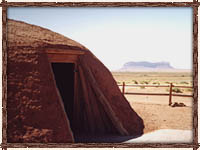 Before we traveled across the highway toward the Monument Valley Visitors Center, we stopped
by an actual Navajo dwelling, known as a hogan. Its doorway faces east, so the morning sun can
bless the household at the beginning of the day. Inside Roselynn introduced us to Lucy, who
showed us rug-weaving, which is a major staple of the modern Navajo's ability to survive.
Before we traveled across the highway toward the Monument Valley Visitors Center, we stopped
by an actual Navajo dwelling, known as a hogan. Its doorway faces east, so the morning sun can
bless the household at the beginning of the day. Inside Roselynn introduced us to Lucy, who
showed us rug-weaving, which is a major staple of the modern Navajo's ability to survive.
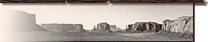
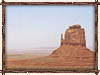
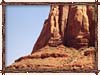
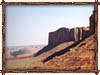
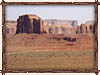
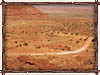
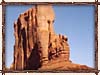
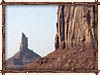
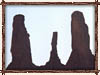
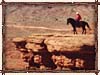
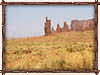
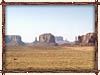
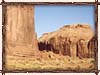
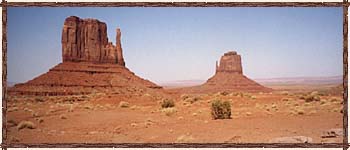 The truck then trundled its way down the tiny path you see at the right, past the Left Mitten and
the Right Mitten, into Monument Valley. The pictures here cannot really capture the stunning
vistas and gigantic towers of rock.
The truck then trundled its way down the tiny path you see at the right, past the Left Mitten and
the Right Mitten, into Monument Valley. The pictures here cannot really capture the stunning
vistas and gigantic towers of rock.

Photos - Click to Enlarge
Click to Enlarge |
There is an area called John Ford's Point, named for the first Hollywood film director to make a
Western using Monument Valley (for the film Stagecoach starring John Wayne). Here is where
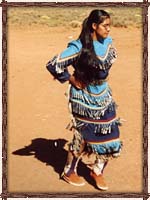
a small group of Navajo eke out a living by providing photo opportunities and selling jewelry. Two
girls performed traditional Navajo dances; Sabrina performed the Grass Dance, and Victoria the
Jingle Dance, which respects the rain which comes so seldom. Afterwards Bianca walked off by
herself and began to write furiously:
I can hear them saying: 'Here, you
oppressor, I will dance for you, for you have given me no choice, no respect and very little land.
So here is your dance of my people, that you have destroyed; my people that go hungry, starving
off the land that once provided for us... the land that is now ours but not really ours.
Appreciative of their efforts but sobered by the experience and not a little disgusted with my
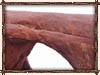
own heritage, we continued. Soon we reached areas between and beneath the behemoth formations, where
we disembarked from the truck and wandered among the red rocks.
Photos - Click to Enlarge
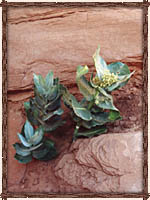 Milkweed. It blooms occasionally among the dust and rock, but the locals keep their animals (such as
goats) away from it, as it is poisonous.
Milkweed. It blooms occasionally among the dust and rock, but the locals keep their animals (such as
goats) away from it, as it is poisonous.
Click to Enlarge |
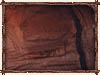
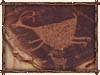
This is very cool. These are petroglyphs, etched by the Anasazi, and they are about 1,300 years
old.
BIANCA: And now for another of Dave's über-nerd information blocks:
Monument Valley is a Navajo Tribal park established in 1958, located on the Arizona/Utah border within
the 16 million-acre Navajo Reservation.
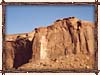
The red-rock formations that inspire us today began as sandy sediments in a Permian ocean two
hundred and seventy million years ago, and before human existence Monument Valley was a lowland
basin. For hundreds of millions of years layer upon layer of eroded sediment from the early Rocky
Mountains was deposited in the basin and cemented into rock... mainly sandstone, siltstone, shale
and limestone. A slow, gentle upwarp created by constant pressure from below the surface has
elevated the horizontal strata. What was once a basin became a plateau of solid rock a thousand
feet high.
Natural forces of wind, rain and temperature have spent the last fifty million years cutting and
peeling away the surface; soft red shale undermines the stronger sandstone, producing the many
buttes and pinnacles, which are composed of Permian-age Cedar Mesa Sandstone. The slopes at their
bases are usually composed of Halgaito shale, while many of the spires have caprocks of red Organ
Rock shale, also from the Permian period. This wearing-down of alternate layers of hard and soft
rock slowly created these natural wonders that today stand between 400 and 1200 feet tall.
The reddish hues in the sand and rock of the valley are due to iron oxide; the black streaks of
desert varnish are manganese oxide.
Monument Valley is the home of the famous "purple sage" of western lore, made more dramatic by the
red sands of the area. There are very few trees in the area because of the extreme dryness and lack
of moisture, but an occasional juniper will appear near the edges of the valley. When moisture is
available, Cliffrose, Rabbitbrush and Snakewood can be seen growing.
|
Our adventure brought us back to the Visitor Center and then to Gouldings, and we were treated
to a near-solar eclipse (well, about a quarter eclipse, but you could see the moon's shadow if you
blinked and strained enough). We drove back to Kayenta and then undertook the near-futile necessity
of finding a decent place to eat. We ended up at the Wagon Wheel Restaurant at the Holiday Inn, which
I do not recommend. The service is terrible and the food worse. Again, I say, refrain from eating
in Kayenta in you can.
One thing we noticed: there are a lot of big dogs here in Arizona. BIG dogs. Big wolf dogs.
DAMAGE REPORT: Dave's stomach rebelled after dinner, and he was kept up most of the night. You'd
think he didn't enjoy this trip, but he did.


|
|